Pastoral Statement on Immigration and Human Dignity - January 2026
Fr. Pete - Light in the Darkness
A Pastoral Statement on Immigration and Human Dignity
Originally Posted: Monday, January 26, 2026
Updated: Tuesday, June 9, 2026
Updated: Thursday, September 17, 2026 -
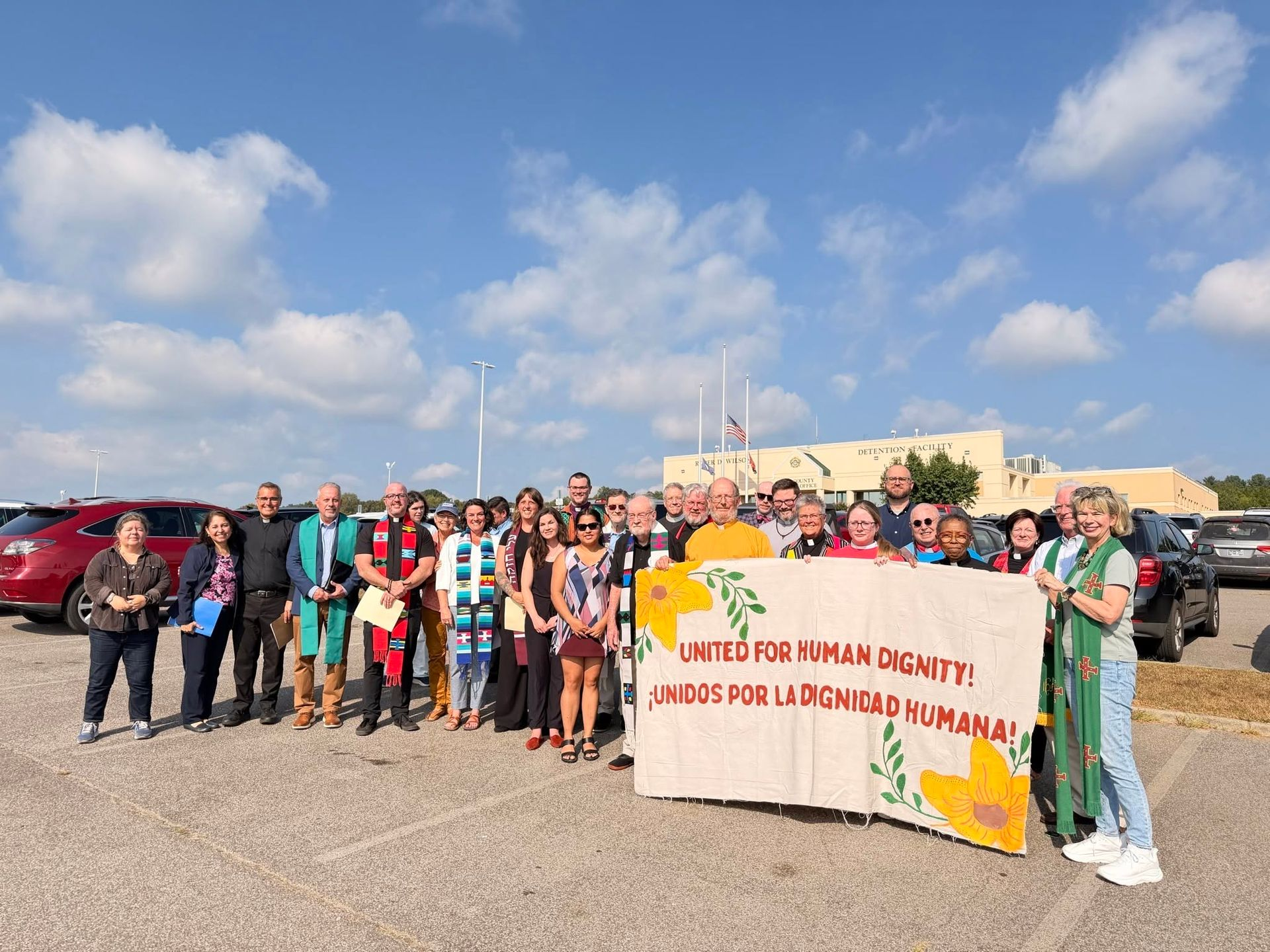
Fr. Pete and East Tennessee Faith Leaders Address Immigration Enforcement in an Open Letter to Community and Government Leaders
Fr. Pete shares thoughts and his homily from this past weekend as well as a set of Church resources inviting us to pray, reflect, and speak with Christian charity in a time of fear and tension.
Dear Parish Family,
I have been touched by the messages, conversations, and requests I have received regarding my homily the weekend of January 25. Thank you to those who shared personal stories, concerns for loved ones and the fear many are carrying right now.
In the wake of the tensions felt in our country regarding immigration over the last few weeks and as we experience the effects in our own community, I desire to share my pastoral reflections.
I invite you to read or listen to my homily from Sunday, January 25. I also invite you to become familiar with teachings of the Catholic Church and recent statements by the Pope and bishops.
I ask all of us to continue praying—praying for peace, praying for those who are afraid, praying for those entrusted with enforcing the law, and praying that our community will be guided by the Gospel. As Catholics, we are invited to allow the pastoral guidance of the Church to shape our words and actions in Christian charity. We are called to put the Word of God into action…treating our neighbors, especially the vulnerable, with dignity.
May our faith be more than words, and may the Eucharist we receive form us into people who bring Christ’s love to all.
Sincerely in Christ,
Fr. Pete Iorio
Pastor
Our Lady of Fatima Catholic Church
Alcoa, TN
Fr. Pete Homily – Sunday, January 25, 2026 – 3rd Sunday in Ordinary Time
Transcript of Homily:
“ ‘The people who walked in darkness have seen a great light;
upon those who dwelt in the land of gloom light has shone.’
I quote from both the first reading from the prophet Isaiah, and it is also from our gospel of Matthew today, which includes the citation from the prophet Isaiah… Matthew is wanting us to know that Jesus is the light, the fulfillment of this prophecy. The gospel also includes the calling of the first of 12 disciples who become under the tutelage of Jesus himself the apostles, the keepers of the faith. Our Catholic Church teaches that the bishops are the successors of the apostles and so speak and teach us by applying the gospel to our times.
While these readings come from thousands of years ago in biblical times, there are many people who feel like there is darkness and gloom in our land and throughout the world today. There are fears of a shifting world order with possible conflicts. Three American Cardinals, who met earlier this month in a consistory with Pope Leo issued a statement. I quote the first two sentences, and I invite you to read the entire statement https://adw.org/news/joint-statement-morality-u-s-foreign-policy-english/ : In 2026, the United States has entered into the most profound and searing debate about the moral foundation for America’s actions in the world since the end of the Cold War. The events in Venezuela, Ukraine and Greenland have raised basic questions about the use of military force and the meaning of peace, they said. There are fears of economic hardship with rising prices. There are concerns regarding the way the issue of immigration is being addressed in our country. Even Pope Leo XIV said he is troubled by the violent and at times "extremely disrespectful" ways migrants have been treated in the United States.
"We have to look for ways of treating people humanely, treating people with the dignity that they have. If people are in the United States illegally, there are ways to treat that. There are courts. There's a system of justice," the Pope said.
"No one has said that the United States should have open borders," the Pope continued. "I think every country has the right to determine who enters, how, and when."
However, he added, "when people have lived good lives—many of them for 10, 15, 20 years—treating them in a way that is, to say the least, extremely disrespectful, and with instances of violence, is troubling."
Shining the light of Christ on darkness is the ministry of bishops. Following the lead of the Holy Father, " The U.S. Conference of Catholic Bishops said. "We pray for an end to dehumanizing rhetoric and violence, whether directed at immigrants or at law enforcement." https://www.usccb.org/news/2025/us-bishops-issue-special-message-immigration-plenary-assembly-baltimore
And there are people concerned that now two people have died in Minneapolis during protests. The light of truth must shine on these situations in order that justice and peace permeate the land. We know from experience that sometimes getting to the truth takes patience and perseverance.
Here at home, I am deeply saddened that recently one of our own parishioners who regularly attends mass at 7 PM on Saturdays was recently taken by ICE. He has no criminal record. And the sad thing is for me that as his pastor, I am forbidden to go to minister to him. Our bishop is very concerned that we are not allowed the freedom of religion and pastoral care that we want to give. We remember that in the gospel of Matthew chapter 25 Jesus said, “I was in prison and you visited me.” The federal government does not allow us to exercise that Christian principle. Our Bishop Mark Beckman issued a letter which is worth reading. I quote one paragraph and I invite you to read the entire letter https://dioknox.org/news/pastoral-message-to-immigrants :
“To the wider community, I remind all that Catholic teaching affirms the right of people to migrate when they cannot find security, livelihood, or life for their families. We also affirm the right of nations to regulate borders in a just manner. These two truths must never be placed in opposition. Justice and mercy must walk together. We therefore encourage policies that respect the law and uphold the dignity of the human person, protecting families and offering fair pathways to stability.”
My brothers and sisters in Christ, Jesus is the light in our darkness, and we are called to stay close to him and trust him whenever fear creeps into our lives. As Christians, we bring the light of Hope to our world, staying true to the gospel and the teaching of the apostles.”
USCCB “Special Pastoral Message on Immigration”
A full text of the bishops’ Special Message (Nov. 12, 2025), calling Catholics to reject indiscriminate mass deportation and dehumanizing rhetoric, and to pursue meaningful reform.
Link- https://www.usccb.org/resources/USCCB%20Special%20Message%20on%20Immigration.pdf
Bishop Mark Beckman (Diocese of Knoxville): “A Pastoral Message to Immigrant Brothers and Sisters”
Bishop Beckman’s message (Dec. 12, 2025) encouraging immigrants, and reminding the wider community of Catholic teaching: the right to migrate when basic needs and safety are not possible, and the right of nations to regulate borders justly—never opposed to human dignity.
Dear Brothers and Sisters in Christ,
Grace and peace to you in the name of our Lord Jesus Christ.
As your bishop, I wish first to speak a word of deep gratitude and affirmation. You, our immigrant and refugee families, enrich the life of this local Church with your faith, your culture, your sacrifices, and your profound love for God and family. Your perseverance in the face of difficulty is a living witness to the Gospel. Please know that you are not strangers among us—you are a cherished and essential part of the Body of Christ.
The Church has always recognized in you the face of Christ Himself. In the Gospel of Matthew, our Lord says, "I was a stranger and you welcomed me". He was born far from home, fled persecution as a child, and lived His life without worldly security. Because of this, the Church stands with you—not only in charity, but in solidarity, defending your dignity and calling the whole community to see in you a sacred presence.
To those who feel fear, uncertainty, or isolation: the Church walks with you. We are committed to offering pastoral care, guidance, and support. Whether you are documented or undocumented, newly arrived or long established, you belong to the Church; your dignity does not depend on a legal status but on the image of God within you.
In these recent weeks, our community has witnessed a painful rise in detentions, deportations, and family separations. Many among us—our friends, neighbors, parishioners, and even our own families—are living with deep fear and uncertainty.
We see our brothers and sisters disappearing from our communities, being taken away without due process and without opportunities for us to provide them with pastoral care.
To the wider community, I remind all that Catholic teaching affirms the right of people to migrate when they cannot find security, livelihood, or life for their families. We also affirm the right of nations to regulate borders in a just manner. These two truths must never be placed in opposition. Justice and mercy must walk together. We therefore encourage policies that respect the law and uphold the dignity of the human person, protecting families and offering fair pathways to stability.
Dear brothers and sisters, do not lose hope. The Church sees you. The Church loves you. And Christ walks with you even in the most uncertain moments. May you always know that this is your home, and may the Holy Spirit give you courage, peace, and renewed strength every day.
I entrust you to the maternal care of Our Lady of Guadalupe, Mother of the Americas and protector of migrants. May she guard your families and lead us closer to her Son, who is the hope of all nations.
Sincerly in Christ,
Most. Rev. Mark Beckman
Bishop of Knoxville
Link- https://dioknox.org/news/pastoral-message-to-immigrants
Tenn. Bishops Release Statement on Immigration Enforcement and the Dignity of Migrants
June 9, 2025
Tennessee Catholic Conference Statement on Immigration Enforcement and the Dignity of Migrants
A Climate of Fear and the Call for Due Process
On June 6, the three bishops of Tennessee along with the Tennessee Catholic Conference released a joint statement in regard to immigration enforcement and the dignity of migrants in light of recent ICE operations in the state of Tennessee.
The full statement can be read below:
In English |
In Español
The recent immigration enforcement action conducted by the Tennessee Highway Patrol and several federal agencies, including Immigration and Customs Enforcement (ICE) in Nashville has spread fear throughout the city’s immigrant community. While the initial period of intensive enforcement has subsided, continued public attention suggests that immigration enforcement may remain a focus, potentially affecting communities across all parts of Tennessee.
Efforts by government officials and law enforcement to address migrants involved with criminal gangs, human trafficking, and drug dealing are greatly appreciated. People involved in these illegal enterprises prey on both the larger immigrant community and all of society. Everyone, no matter their immigration status, should be protected from these bad actors.
A press release issued by ICE following the enforcement activity in Nashville spotlighted seven individuals with significant charges or convictions. The release noted that of the 196 individuals arrested, 95 had prior criminal convictions and pending criminal charges, and that 31 previously removed individuals had reentered the United States illegally.
Doing the math on the numbers presented in the ICE release, perhaps as many as 100 of those detained, while undocumented, apparently had no previous criminal issues. That brings into question whether the enforcement activity was principally targeted at those who should have no place in our communities because of their own illegal activity.
The fact that so many people without documentation could quietly live under the radar, often for decades, clearly points to the need for broad reform of the immigration system.
As we expressed in our statement released on December 28, 2024, the Feast of the Holy Family, when we joined the Catholic Bishops of Kentucky—united as the Metropolitan Province of Louisville—we reaffirm our prayerful support and unwavering solidarity with our immigrant sisters and brothers. Immigrants and their families are a cherished gift to our world.
In accordance with Catholic Social Teaching, the Church will continue to advocate for the dignity and just treatment of all migrants. We affirm both the right of individuals to migrate in order to support themselves and their families, and the right of nations to regulate their borders and establish migration policies. These rights, however, must be exercised in ways that uphold the dignity of every human being and serve the common good.
For decades, the Catholic Church in the United States and in Tennessee has called for comprehensive immigration reform—reform that includes:
• A strong border with immigration policies that allow for controlled migration enforced in a humane and just manner
• Support for family reunification
• Protections for those fleeing violence or persecution
• Access to legal representation and due process
• Pathways to legal status and citizenship
We recognize that fundamental human rights stem from the inherent dignity of being created in the image and likeness of God. We invite members of the Catholic community to deepen their understanding of immigration issues through the lens of the faith, and to advocate for humane and just immigration laws and policies.
We are particularly concerned by reports that recent enforcement efforts in the Nashville area have extended beyond individuals charged with serious crimes or those subject to final deportation orders. In the current climate, many individuals face a lack of due process, which contributes to widespread fear, especially the fear of being detained while simply attending Mass or participating in parish life.
As of June 2025, immigration policy at the southern U.S. border has seen significant changes under the Trump administration. Border security has been strengthened and attempted undocumented crossings are at historic lows. However, it is essential that efforts to address decades long shortcomings in immigration enforcement respect due process and the dignity of every person.
The Church stands ready to continue working with communities, legislators, and leaders to pursue immigration reform that reflects the values of justice, compassion, and human dignity. We invite all people of goodwill to join us in this vital mission.
Most Reverend J. Mark Spalding
Bishop of Nashville
Most Reverend David P. Talley
Bishop of Memphis
Most Reverend Mark Beckman
Bishop of Knoxville
Rick Musacchio
Executive Director
Tennessee Catholic Conference
References & Catholic Teaching on Immigrants and Refugees
Referenced Statements & Resources:
- USCCB “Special Pastoral Message on Immigration” (PDF) A full text of the bishops’ Special Message (Nov. 12, 2025), calling Catholics to reject indiscriminate mass deportation and dehumanizing rhetoric, and to pursue meaningful reform. https://www.usccb.org/resources/USCCB%20Special%20Message%20on%20Immigration.pdf (usccb.org)
- USCCB news release announcing the Special Message - A short overview explaining why the bishops issued this special form of statement and what it emphasizes. https://www.usccb.org/news/2025/us-bishops-issue-special-message-immigration-plenary-assembly-baltimore(usccb.org)
- USCCB: “Pope calls treatment of migrants in U.S. ‘extremely disrespectful’” (CNS/Cindy Wooden) Coverage of Pope Leo XIV’s remarks supporting the U.S. bishops’ message and criticizing mistreatment of migrants, while noting borders can be regulated. https://www.usccb.org/news/2025/pope-calls-treatment-migrants-us-extremely-disrespectful(usccb.org)
- Bishop Mark Beckman (Diocese of Knoxville): “A Pastoral Message to Immigrant Brothers and Sisters” - Bishop Beckman’s message (Dec. 12, 2025) encouraging immigrants, and reminding the wider community of Catholic teaching: the right to migrate when basic needs and safety are not possible, and the right of nations to regulate borders justly—never opposed to human dignity. https://dioknox.org/news/pastoral-message-to-immigrants (Diocese of Knoxville)
- Three U.S. Cardinals: “Joint Statement on the Morality of U.S. Foreign Policy” (Archdiocese of Washington) - A January 19, 2026 statement from Cardinals Cupich, McElroy, and Tobin framing foreign policy through human dignity, peace, and moral limits on force, referencing Pope Leo XIV’s guidance to diplomats. https://adw.org/news/joint-statement-morality-u-s-foreign-policy-english/(Archdiocese of Washington)
- Vatican News: “Three US Cardinals: Foreign policy must respect human dignity, religious liberty” - Vatican News coverage summarizing the cardinals’ statement and placing it in the context of Pope Leo XIV’s “State of the World” address. https://www.vaticannews.va/en/church/news/2026-01/united-states-cardinals-cupich-mcelroy-tobin-foreign-policy.html(Vatican News)
- Pope Leo XIV: Angelus, January 25, 2026 (official text) - The Holy Father’s Angelus text from the Sunday referenced in multiple statements urging peace and respect for peoples. https://www.vatican.va/content/leo-xiv/en/angelus/2026/documents/20260125-angelus.html(Vatican)
- Vatican News: “US Bishops urge respect for human life after Minneapolis killings” - Coverage of Archbishop Coakley’s call for calm, restraint, and respect for human life, connecting it to Pope Leo XIV’s Angelus message. https://www.vaticannews.va/en/church/news/2026-01/usa-bishops-urge-restraint-ice-killings-minneapolis.html(Vatican News)
- USCCB: “Archbishop Coakley Urges Calm, Restraint, and Respect for Human Life in Minneapolis” - USCCB president Archbishop Coakley’s statement responding to violence in Minneapolis and calling the nation toward dialogue and peace. https://www.usccb.org/news/2026/archbishop-coakley-urges-calm-restraint-and-respect-human-life-minneapolis(usccb.org)
- Archdiocese of Saint Paul & Minneapolis: statement on deadly ICE-related shooting (Jan. 7, 2026) - Archbishop Bernard Hebda’s statement calling for prayer and peace following the first January shooting connected to enforcement tensions. https://www.archspm.org/statement-regarding-deadly-ice-related-shooting-in-minneapolis/(Saint Paul and Minneapolis Archdiocese)
- Archdiocese of Saint Paul & Minneapolis: statement on the death of Alex Pretti (Jan. 25, 2026) - Archbishop Hebda’s follow-up statement inviting prayer after a second tragic death amid ongoing tensions. https://www.archspm.org/statement-regarding-the-death-of-alex-pretti-and-invitation-to-prayer/(Saint Paul and Minneapolis Archdiocese)
Catechism of the Catholic Church
Directly on immigration / the foreigner
- CCC 2241 — Duties of nations toward the foreigner; right to migrate for livelihood/security; governments may regulate borders for the common good; obligations of immigrants. (Primary CCC reference.)
Human dignity, equality, and non-discrimination
- CCC 1929–1933 — Social justice and respect for the human person in society.
- CCC 1931–1935 — Equality, dignity of all persons; condemnation of discrimination that violates basic rights.
The common good, solidarity, and social responsibilities
- CCC 1905–1912 — The common good (conditions that allow people/groups to reach fulfillment more fully).
- CCC 1913–1917 — Participation and the duty to contribute to society.
- CCC 1939–1942 — Solidarity: responsibility for the weak and vulnerable; social charity.
Authority, law, and conscience
- CCC 1897–1904 — Legitimate authority and its purpose (service of the common good).
- CCC 2234–2243 — Duties of citizens and authorities; moral limits of law; conscience and the state.
Rights of persons, work, and exploitation (often relevant to migrants)
- CCC 2401–2406 — The universal destination of goods and private property (how property serves human dignity).
- CCC 2433–2436 — Economic life, justice in labor, and protections for workers (often cited re: migrant labor).
- CCC 2419–2425 — Business/economic ethics, exploitation, and justice in social/economic relations.
Family unity and protection of the vulnerable
- CCC 2201–2206 — The family as the fundamental cell of society (relevant to policies that separate families).
- CCC 2270–2275 — Respect for human life (commonly referenced in “life and dignity” discussions, including migrants/refugees who are vulnerable).
Sacred Scripture:
Old Testament: Law
- Leviticus 19:33–34 — “Love the foreigner as yourself.” Command not to mistreat the foreigner; to treat them as native-born and love them as oneself. https://bible.usccb.org/bible/leviticus/19
- Exodus 22:20–23 (esp. v. 21) — Do not oppress the resident alien. Prohibits wrongdoing or oppressing the “alien,” grounding it in Israel’s own experience as aliens in Egypt. https://bible.usccb.org/bible/exodus/22
- Deuteronomy 10:18–19 — God loves the resident alien; so must we. God executes justice for the vulnerable and “loves the resident alien”; the people are commanded to love the resident alien. https://bible.usccb.org/bible/deuteronomy/10
- Deuteronomy 24:17–22 — Justice for the foreigner; provision for the poor through gleaning. Forbids depriving the foreigner of justice and commands leaving portions of harvest for the foreigner, orphan, and widow. https://bible.usccb.org/bible/deuteronomy/24
Old Testament: Prophets and Wisdom
- Zechariah 7:9–10 — Do not oppress the widow, orphan, resident alien, or poor. A clear prophetic summary of justice and compassion, explicitly naming the resident alien among those not to be oppressed. https://bible.usccb.org/bible/zechariah/7
- Isaiah 58:6–8 (esp. v. 7) — True worship includes sheltering the homeless. Links authentic fasting to concrete mercy: sharing bread, welcoming the homeless/afflicted, clothing the naked. https://bible.usccb.org/bible/isaiah/58
- Psalm 146:9 — The Lord protects the resident alien. Proclaims God’s active protection of the resident alien, orphan, and widow. https://bible.usccb.org/bible/psalms/146
New Testament: Gospels
- Matthew 25:35–40 — “I was a stranger and you welcomed me.” Jesus identifies himself with the stranger and the vulnerable; what we do for them, we do for Christ. https://bible.usccb.org/bible/matthew/25
- Matthew 2:13–15 — The Flight into Egypt. The Holy Family flees violence and becomes displaced—an enduring biblical image for refugees and those seeking safety. https://bible.usccb.org/bible/matthew/2
- Luke 10:25–37 — The Good Samaritan. Defines “neighbor” beyond boundaries of identity; mercy becomes the measure of faithful love. https://bible.usccb.org/bible/luke/10
New Testament: Letters
- Hebrews 13:2–3 — Hospitality to strangers; solidarity with prisoners and the mistreated. Commands hospitality and calls believers to remember prisoners and the ill-treated as if sharing their suffering. https://bible.usccb.org/bible/hebrews/13
- Ephesians 2:19 — “No longer strangers… but members of the household of God.” A theological grounding for belonging: in Christ, divisions are overcome and outsiders are brought into communion. https://bible.usccb.org/bible/ephesians/2
Papal/Vatican Documents, USCCB, & Major Conciliar Teaching:
Gaudium et Spes
- Dignity of the person; condemnation of dehumanizing treatment; foundations for human rights and solidarity.
- https://www.vatican.va/archive/hist_councils/ii_vatican_council/documents/vat-ii_const_19651207_gaudium-et-spes_en.html
Roman Curia / Holy See Documents Focused on Migration:
Exsul Familia (Pius XII, 1952)
- A foundational modern-era Church text on the spiritual care of migrants and refugees (available on Vatican.va; Latin).
- https://www.vatican.va/content/pius-xii/la/apost_constitutions/documents/hf_p-xii_apc_19520801_exsul-familia.html (Vatican)
Erga Migrantes Caritas Christi (2004)
- A comprehensive Church instruction on the pastoral care of migrants, parish life, and pastoral responsibilities
- (Official Vatican listing / related pages) https://www.vatican.va/roman_curia/pontifical_councils/migrants/pom2009_111/rc_pc_migrants_pom111_pastoral%20response-marchetto.html(Vatican)
Compendium of the Social Doctrine of the Church
- A one-stop reference for Catholic social doctrine; includes indexed sections on immigration and the conditions and social integration of immigrants.
- https://www.vatican.va/roman_curia/pontifical_councils/justpeace/documents/rc_pc_justpeace_doc_20060526_compendio-dott-soc_en.html(Vatican)
Other Immigration Related Entries:
U.S. Bishops’ Foundational Documents and Resources:
Strangers No Longer: Together on the Journey of Hope (2003)
- A pastoral letter from the U.S. and Mexican bishops laying out principles for migration, family unity, and humane policy.
- https://www.usccb.org/issues-and-action/human-life-and-dignity/immigration/strangers-no-longer-together-on-the-journey-of-hope(usccb.org)
Catholic Social Teaching on Immigration and the Movement of Peoples (USCCB)
- A study/action resource that ties Scripture and CST principles to immigration questions.
- https://www.usccb.org/issues-and-action/human-life-and-dignity/immigration/catholic-teaching-on-immigration-and-the-movement-of-peoples(usccb.org)
Migration and Catholic Social Teaching (USCCB quick reference, PDF)
- A concise handout summarizing key principles (rights, responsibilities, borders, protection, dignity).
- https://www.usccb.org/resources/migrationandCST(usccb.org)
Quotes from Church teachings on the rights of migrants and refugees (USCCB)
- A curated quotation set for bulletins, study groups, and formation.
- https://www.usccb.org/issues-and-action/human-life-and-dignity/migrants-refugees-and-travelers/quotes-rights-migrants-refugees(usccb.org)
Welcoming the Stranger Among Us: Unity in Diversity (USCCB)
- A pastoral framework for parishes/dioceses to welcome immigrants and build communion across cultures.
- https://www.usccb.org/committees/pastoral-care-migrants-refugees-travelers/welcoming-stranger-among-us-unity-diversity
Our Lady of Fatima